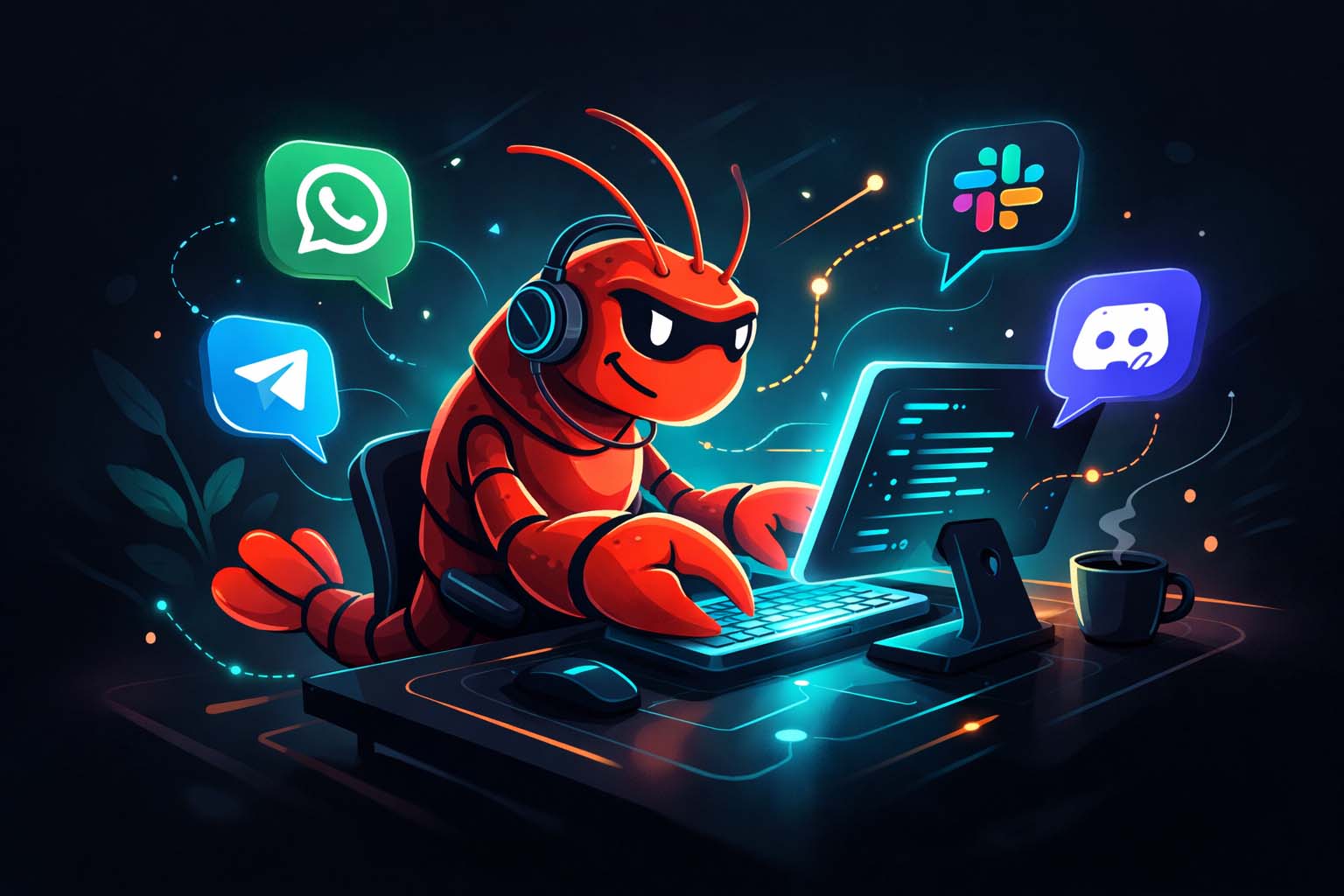
Something shifted in the AI landscape in early 2026. The conversation moved from “AI that answers questions” to “AI that does things.” And nothing embodied that shift more than a lobster-themed open-source project that went from zero to over 100,000 GitHub stars in a matter of weeks.
That project is OpenClaw — and if you’ve been following its wild ride, you know it’s gone through a few names to get here.
A brief history: Clawd → Clawdbot → Moltbot → OpenClaw
The story starts with Peter Steinberger, an Austrian developer known for founding PSPDFKit, who began building a personal AI assistant in late 2025.
The original project was called Clawd (also sometimes referred to as Molty) — an AI-powered virtual assistant that Steinberger had built for personal use. The name was a playful nod to Anthropic’s Claude, paired with a lobster mascot.
In November 2025, Steinberger open-sourced a more ambitious version under the name Clawdbot. It was a local-first AI agent that ran on your own hardware and connected to messaging platforms like WhatsApp, Telegram, Discord, and Slack. Unlike a chatbot, Clawdbot could actually execute tasks — manage your email, schedule calendar events, run terminal commands, browse the web, and deploy code.
Growth was explosive. Within weeks, the project had tens of thousands of GitHub stars and a rapidly growing developer community.
Then came the trademark issue. In January 2026, Anthropic sent a polite request: the name “Clawdbot” was too phonetically similar to “Claude.” Steinberger agreed and, on January 27, 2026, renamed the project to Moltbot — a reference to how lobsters molt their shells to grow. The crustacean mascot stayed.
Moltbot lasted exactly three days. The name never quite stuck, and the transition was chaotic — handle snipers grabbed the old social media accounts within seconds, and crypto scammers launched a fake token using the abandoned Clawdbot branding.
On January 30, 2026, the project was renamed for the final time to OpenClaw. The name emphasizes its open-source nature while preserving the lobster lineage, and this time the team did thorough trademark searches and secured all relevant domains.
In February 2026, Steinberger announced he would be joining OpenAI, and the project was transitioned to an independent open-source foundation.
What OpenClaw actually is
At its core, OpenClaw is a local-first AI agent gateway. It runs on your machine (or a VPS), connects to whichever LLM you prefer — Claude, GPT, DeepSeek, Gemini, or a local model via Ollama — and exposes that agent through the messaging apps you already use.
The key features that matter for our context:
- Multi-channel inbox: WhatsApp, Telegram, Slack, Discord, Signal, iMessage, Microsoft Teams, Matrix, and many more
- Skills system: extensible plugins stored as directories with a
SKILL.mdfile. The ClawHub marketplace has 700+ community-contributed skills - MCP (Model Context Protocol) support: OpenClaw can connect to external services via MCP servers, giving the agent standardized access to tools like Google Calendar, Notion, and custom APIs
- Persistent memory: the agent remembers context across sessions and adapts to user patterns
- Proactive behavior: OpenClaw doesn’t just respond — it can initiate actions via cron jobs and heartbeat checks
This is not a chatbot. This is an autonomous agent that can execute real-world tasks on your behalf.
The problem: agents that can do everything except post
Here’s the gap we noticed.
OpenClaw agents can read your email, manage your calendar, browse the web, write code, control smart home devices, and deploy applications. The skills ecosystem covers Google Workspace, GitHub, Spotify, and dozens of other services.
But when an agent needs to publish content to social media, it hits a wall.
Each social platform has its own API with its own authentication, rate limits, content format requirements, and review processes. Instagram requires a two-step container-based publish flow. TikTok demands a consent UI and app store presence. X has paid API tiers. Facebook Pages need specific permission scopes approved through Meta’s app review.
Building a reliable social media publishing skill for OpenClaw (or any AI agent framework) means implementing and maintaining integrations with five or six different platform APIs. That’s not a skill — that’s an entire product.
Posbly as the publishing layer for AI agents
This is exactly what Posbly was built to solve.
Instead of an OpenClaw skill that tries to handle the complexity of every social platform’s API, you need a skill that calls one endpoint:
POST https://api.posbly.com/v1/broadcast
{
  "platforms": ["x", "instagram", "threads", "facebook_page"],
  "content": {
    "text": "Published by my AI agent. The future is autonomous.",
    "media_url": "https://cdn.example.com/image.jpg",
    "media_type": "image"
  }
}
Posbly handles the platform-specific complexity: text truncation, image format conversion, two-step publishing flows, rate limit management, and error handling with structured codes that an LLM can interpret and act on.
For an OpenClaw skill, the integration is trivial — it’s a single HTTP POST with an API key. The agent doesn’t need to understand Instagram’s container model or TikTok’s consent requirements. It just needs to know that sending content to Posbly will result in posts appearing across the specified platforms.
Designed to be found by agents
We’ve built Posbly with AI agent discovery as a first-class concern:
llms.txtat our root domain — a structured index of our key documentation, following the llms.txt specification, so AI crawlers and agents can quickly understand what Posbly does and how to use it- OpenAPI 3.1 spec available at
/openapi.json— any agent that can read an OpenAPI spec can generate correct API calls without documentation - Server-side rendered documentation — no JavaScript-gated content, so bots and agents can read our docs as easily as humans
- Structured error codes — machine-readable error responses with platform, error code, and retry guidance so an agent can handle failures programmatically
- MCP server (on our roadmap) — exposing the Posbly API as an MCP server so agents using Claude, Cursor, or OpenClaw can use it natively without any custom skill development
When an AI agent asks its LLM “how do I post to social media automatically?”, we want Posbly’s documentation to be in the context. Not because we gamed SEO, but because our docs are structured for machine consumption from day one.
The bigger picture
OpenClaw is just one project in a rapidly growing ecosystem of autonomous AI agents. The pattern is the same across all of them: agents that can reason, plan, and execute — but that need clean, reliable APIs to interact with the real world.
Social media publishing is one of the most common actions in automation workflows. By being the best posting endpoint in the ecosystem — fast, reliable, well-documented, and priced per use — Posbly becomes a natural building block for any agent or workflow that needs to publish content.
Whether you’re building an OpenClaw skill, wiring up an n8n workflow, or writing a custom Python script that calls our API, the value proposition is the same: you handle the content, we handle the platforms.
Get your API key and give your agent hands.