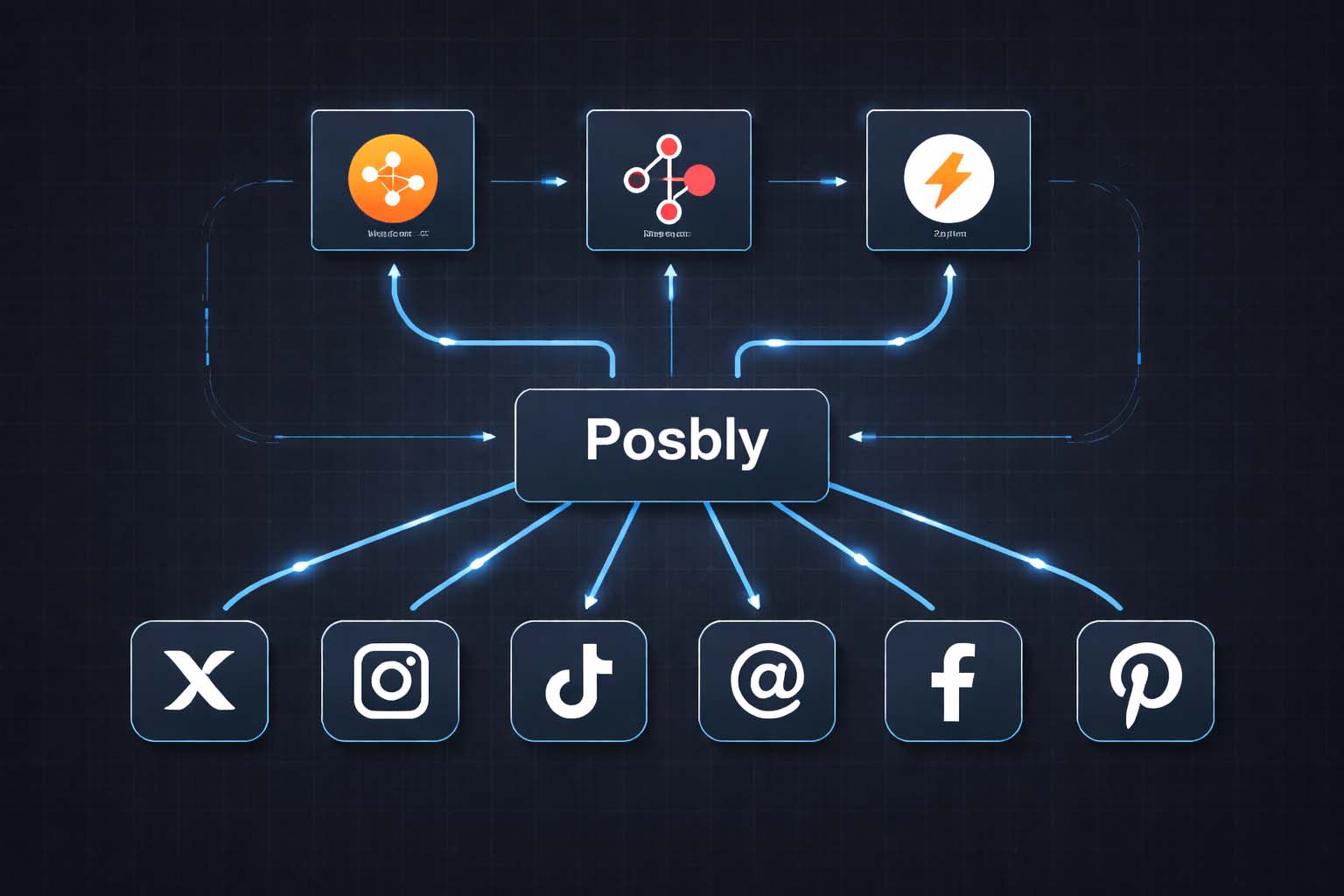
Posbly’s API works today. You can call POST /v1/broadcast, pass in your content and target platforms, and have posts go live across X, Instagram, Facebook Pages, Threads, Pinterest, and TikTok within seconds.
But we know that most automation builders don’t start with raw HTTP requests. They start with Make.com, n8n, or Zapier — and they expect the tools they use to show up in those platforms as native, drag-and-drop modules.
That’s what we’re building next, and this post lays out exactly what’s coming.
Why native connectors matter
You can already use Posbly from any automation platform today. Make.com has an HTTP module. n8n has an HTTP Request node. Zapier has Webhooks by Zapier. You configure the endpoint, headers, and body, and it works.
But there’s a meaningful difference between “works with a generic HTTP module” and “shows up as a native app in the connector marketplace.”
When Posbly has a native Make.com connector, anyone searching for “post to Instagram” or “social media automation” in Make’s app directory will find us. They’ll see purpose-built modules with labeled fields — platform selector, text input, media URL, schedule time — instead of a raw JSON body they have to construct manually.
That discovery alone changes everything. It’s the difference between us finding our users and our users finding us.
What we’re building for each platform
Make.com — Technology Partner Program
Make.com is our top priority. Its visual scenario builder is the natural home for broadcast workflows, and Make’s Technology Partner Program gives listed connectors real distribution — their partners report strong year-over-year growth after joining the marketplace.
We’re building five modules for the Make.com connector:
- Create Post — publish to a single platform with full control over platform-specific options
- Broadcast Post — publish to multiple platforms in one step, the core Posbly workflow
- Schedule Post — queue a post for a specific date and time, with timezone handling built in
- Get Post Status — poll a broadcast or job ID to check per-platform results
- Watch Post Status (trigger) — a webhook trigger that fires when a post succeeds or fails, so downstream steps can react automatically
The Make connector is being built with the Make App SDK and will be submitted to the Technology Partner Program for listing in the public app directory. Our goal is to have it available — even if pending final review — within the next few weeks.
n8n — Community Node
n8n’s self-hosted, open-source ethos aligns well with the kind of builders who use Posbly. The platform has hundreds of community-contributed workflow templates for social media, and our node will plug directly into all of them.
We’re building two nodes:
- Posbly node — the main action node with resource selectors for platform, post type, content fields, and scheduling. Supports both single-platform posts and multi-platform broadcasts.
- Posbly Trigger node — a webhook trigger that listens for post status events (success, failure, partial success) and passes the payload to downstream nodes.
The node will be published as an npm package following n8n’s community node specification and submitted to the community node registry. n8n users will be able to install it directly from Settings → Community Nodes.
Zapier — Developer Platform
Zapier has the largest user base of the three platforms, with over 7,000 apps in its directory. A Posbly listing there puts us in front of every non-technical automation builder who searches for social media publishing.
We’re building:
- Actions: Create Post, Broadcast Post, Schedule Post
- Triggers: Post Published (fires on success), Post Failed (fires on failure)
The Zapier app is being built with the Zapier CLI and will be submitted for public directory listing.
Workflow templates: showing, not just telling
Connectors alone aren’t enough. People need to see what’s possible. Alongside the native integrations, we’re building and publishing a library of ready-to-use workflow templates for each platform:
Google Sheets content calendar — a spreadsheet where each row is a scheduled post. A Make.com scenario (or n8n workflow, or Zapier zap) watches for new rows and fires them through Posbly at the scheduled time. Simple, familiar, and immediately useful for small teams.
Airtable agency queue — for agencies managing multiple clients. An Airtable base with views per client, approval status columns, and a trigger that publishes approved posts through Posbly to the client’s connected accounts.
Notion publish trigger — mark a Notion page as “Ready to publish” and a workflow picks up the content, formats it for social, and broadcasts it via Posbly.
RSS/blog auto-broadcast — monitor an RSS feed (or a webhook from your CMS) and automatically publish a social post every time a new article goes live. This is the “set it and forget it” workflow that content teams love.
AI caption generation pipeline — feed a product image or blog URL into an AI model (Claude, GPT, or any LLM), generate platform-optimized captions, and publish them through Posbly in a single automated flow.
Shopify/WooCommerce new product auto-post — when a new product is published in your store, automatically create social posts with the product image, description, and link across all your connected platforms.
CRM/analytics webhook updates — when a post succeeds, fire a webhook to update your CRM, analytics dashboard, or internal tracker with the post URL and engagement data.
Each template will be published with full documentation, screenshots, and a walkthrough — available both in our docs and on the respective automation platform’s template galleries.
Platform coverage: what’s coming after the integrations
While we build out the automation connectors, we’re also expanding platform support:
- LinkedIn Pages — we’ve started the application process for LinkedIn’s Community Management API. LinkedIn’s approval isn’t guaranteed, so we’re treating it as an upside rather than a blocker. But for the agency use case, LinkedIn is the most-requested addition.
- Bluesky — Bluesky uses the open AT Protocol, which means no app review, no paid API tier, and no approval process. This is the easiest platform to add and it’s coming soon.
- YouTube (evaluating) — YouTube’s upload API is feasible but constrained by daily upload quota ceilings. We’re assessing whether the value justifies the integration complexity for a broadcasting use case.
The vision: Posbly as a posting primitive
The word “primitive” in software means a fundamental building block that other things are built on top of. Stripe is a payment primitive. Twilio is a messaging primitive. S3 is a storage primitive.
We want Posbly to be the posting primitive for social media inside automation workflows.
That means being reliable enough that you trust it in production, cheap enough that you don’t think about cost, well-documented enough that an AI agent can figure out how to use it, and available in every platform where automation builders work.
The native connectors for Make.com, n8n, and Zapier are the next big step toward that goal. They take Posbly from “a great API if you know about it” to “the thing that shows up when you search for social media publishing in your automation tool.”
We’ll share updates as each connector ships. In the meantime, the API is live and ready — get your key and start building.